


Cannabis smells like a skunk because of one specific molecule. Not terpenes, not myrcene, not any of the compounds the industry pointed to for decades. The real source is a volatile sulfur compound called 3-methyl-2-butene-1-thiol, more commonly referred to as 321MBT. Here’s the chemistry behind it, why the terpene assumption persisted for so long, and what a strong skunk smell actually tells you about the flower in your hand.
The Molecule Behind the Smell
321MBT belongs to a class of compounds called volatile sulfur compounds, or VSCs. It carries a reactive thiol group — a sulfur-hydrogen bond — that places it in the same chemical family as the defensive spray a skunk actually deploys. That’s not a loose analogy. The structural overlap is exact, which is precisely why your nose processes both smells as the same thing.
The same compound also forms in light-struck beer. When UV light hits hop compounds in clear or green bottles, it triggers a reaction that produces 321MBT through a different formation pathway but an identical molecule. This is why brewers use brown glass. Cannabis and hops are botanical relatives, both members of the Cannabaceae family, so the shared chemistry isn’t coincidental. The molecule that ruins your beer is the same one that makes your flower worth opening.
Why Terpenes Got the Credit for So Long
Terpenes are genuinely significant compounds in cannabis. They produce the citrus, pine, floral, and earthy notes that give different strains their distinct character, and they’re present in flower at high concentrations. That last point is exactly what caused the confusion.
VSCs like 321MBT are present in cannabis at trace levels, measured in parts per trillion. Terpenes are present in the same flower at concentrations thousands of times higher. When the most abundant compounds look like the obvious answer, trace-level molecules go unnoticed. The terpene assumption held because most aroma analysis happens at close range, where high terpene concentrations dominate the air. VSCs were overlooked not because they aren’t responsible, but because the tools and assumptions of early cannabis science weren’t looking in the right place.
The correction matters because terpenes simply cannot produce the skunk character. Remove 321MBT from the equation and the skunk smell disappears entirely. Terpenes are responsible for a lot, but not for that. Browse The Purple Leaf’s flower selection to explore strains across the full range of aroma profiles.
Why VSCs Fill a Room From Parts Per Trillion
The human nose detects volatile sulfur compounds at concentrations measured in parts per trillion. Terpenes can be present at concentrations thousands of times higher in the same flower and still not dominate what you perceive, because the sensitivity gap is that extreme. A sealed jar of properly cured flower can fill a car because 321MBT requires almost no airborne molecules to register as a strong and recognizable smell.
There’s also a second effect worth knowing. At close range, high terpene concentrations in the surrounding air partially mask VSCs. As air disperses away from the source, terpenes attenuate faster than the more volatile sulfur compounds, leaving 321MBT increasingly dominant at a distance. This is why a cannabis grow facility often smells skunkier to a neighbour a block away than to the worker standing inside it. The molecule becomes relatively more prominent as terpenes thin out.
VSC production in the plant also follows a specific timeline. They’re nearly absent during the vegetative stage, rise sharply in the final weeks of flowering, and continue building through drying and curing. Fresh, properly cured flower smells loudest because VSCs are at peak concentration. Older flower loses those sharp top notes first as volatile compounds evaporate gradually in storage.
Three Aroma Profiles, Three Sulfur Compounds
321MBT is one molecule within a broader VSC family, and the variation within that family is why strains can smell so different from one another even when terpene profiles are similar. Three main aroma categories map to three distinct sulfur compound types.
Classic skunk is driven by 321MBT dominance. The aroma is sharp, sulfurous, and often described as gassy or fuel-adjacent. This is the profile associated with OG Kush, Skunk No. 1, and Chemdog lineages.
Tropical and sweet profiles come from longer-chain thiol derivatives, compounds whose extended carbon structure reads to the nose as passion fruit, guava, or citrus. Tangie and tropical hybrids are the most recognizable examples of this profile.
Savory and garlicky profiles involve a combination of VSC types that produces the end of the spectrum sometimes described as roadkill, dumpster, or intensely fermented. GMO, also known as Garlic Cookies, is the most widely recognized strain in this category.
The aroma profile maps to sulfur compound family, not to indica or sativa designation, and not reliably to strain name. A strain can carry Skunk No. 1 lineage and smell tropical if VSC expression shifted during breeding. A strain with no Skunk lineage at all can smell intensely skunky if it produces high 321MBT. What you smell from the jar is more reliable information than what the label says. The Purple Leaf carries flower across all three of these aroma profiles — ask the team what’s currently in stock and what they’re smelling.

How Breeding Changed the Way Modern Weed Smells
The sharp sulfurous skunk character wasn’t always the default aroma in cannabis. Before the 1980s, most available cannabis was dominated by landrace varieties with mild, earthy, and herbal profiles. That changed with the introduction of Skunk No. 1, a strain bred in 1970s California that brought high VSC expression into a market that had previously run almost entirely on terpene-forward genetics. Crucially, Skunk No. 1 also carried higher cannabinoid content than the landraces it displaced. Skunky aroma and strong potency arrived together in the same genetics, and that correlation held for two decades.
Then legalization changed what breeders were optimizing for. With hundreds of strains competing for shelf space and consumer attention, selection pressure shifted toward terpene complexity, dessert profiles, and fruit-forward aromas. The Cookies family, Gelato, Wedding Cake, and similar cultivars were selected for terpene expression, not sulfur dominance. VSC levels dropped as a result. Much of the market moved away from the classically skunky smell without that representing a quality decline, just a different set of breeding priorities.
The naming problem this created is real. A product labelled Skunk No. 1 today may smell sweet and citrusy because decades of commercial cultivation gradually selected away from VSC expression while the strain name remained unchanged. The strain kept the name. The molecule moved on.
Does Skunky Weed Actually Mean Better Weed?
The historical association between skunky aroma and potency was real, but it was indirect. Skunk No. 1 genetics brought both VSC-heavy aroma and higher cannabinoid content than the landraces they replaced, and the correlation held long enough to become a reliable shorthand. Modern evidence breaks the rule cleanly. High-potency strains in the Cookies and Gelato families consistently carry low VSC profiles while testing at the top of the cannabinoid range. The molecule that determines the skunk smell and the molecules that determine cannabinoid potency are produced through entirely separate biochemical pathways in the plant. One tells you nothing reliable about the other.
What skunky smell does reliably indicate is VSC activity, which reflects freshness and proper curing and storage. A flower that smells aggressively skunky was likely cured well, handled properly, and hasn’t lost its volatile character to heat, light, or age. That’s meaningful information, even if it’s not information about THC percentage.
One thing worth knowing: not every intense cannabis smell is a positive signal. Ammonia indicates bacterial contamination. A damp, musty character that’s distinct from sulfur points to mould. If you’re uncertain which you’re smelling, trust the distinction. The skunk note is sharp and sulfurous. Ammonia is unmistakably chemical and eye-watering. Mould is damp and earthy in a way that reads as wrong rather than pungent. Legal cannabis products purchased from a licensed retailer like The Purple Leaf have been tested and verified before reaching the shelf, which removes a significant part of that concern.
What No Lab Report Currently Measures
Standard cannabis lab testing in Canada covers cannabinoid potency, residual solvents, pesticides, heavy metals, and microbial contaminants. No commercial lab currently tests for VSC concentrations. The Certificate of Analysis tells you what’s in the product in terms of cannabinoids and safety. The skunk question still belongs entirely to your nose. Every product sold through a licensed Canadian retailer like The Purple Leaf comes with verified potency and safety testing, but the aroma assessment remains the one thing no document can do for you.
Frequently Asked Questions
Is it normal for cannabis to smell like skunk?
Yes, completely. The skunky smell comes from volatile sulfur compounds that develop naturally during the plant’s flowering and curing stages. The smells worth being cautious about are ammonia, which signals bacterial contamination, and a damp musty character, which points to mould. A sharp, sulfurous skunk note is a normal and often positive characteristic of well-grown, properly cured flower.
Does skunky weed mean it’s more potent?
Not reliably. The historical connection between skunk aroma and potency existed because the genetics that introduced high VSC expression also happened to carry higher cannabinoid content than earlier varieties. That was a coincidence of genetics, not chemistry. VSCs and cannabinoids are produced through entirely separate pathways in the plant. A strong skunk smell is a good indicator of freshness and proper curing. It tells you little about THC percentage.
Why does the same strain smell different from one producer to another?
Because VSC expression is influenced by genetics, growing environment, curing methods, and storage conditions, and all of those variables differ between producers. Two products with the same strain name can have meaningfully different aroma profiles depending on which phenotype was selected, how it was grown, and how it was processed after harvest. The name on the label is a starting point. What you smell when you open the container is the actual information.
Why does cannabis smell stronger from across the room than up close?
Because terpenes attenuate faster than volatile sulfur compounds as air disperses. At close range, high terpene concentrations partially mask the VSCs. As the air spreads outward, terpenes thin out faster than 321MBT, leaving the sulfur compound increasingly dominant at a distance. The molecule becomes more prominent in your nose the further away from the source you are.
Does proper storage affect how long the skunk smell lasts?
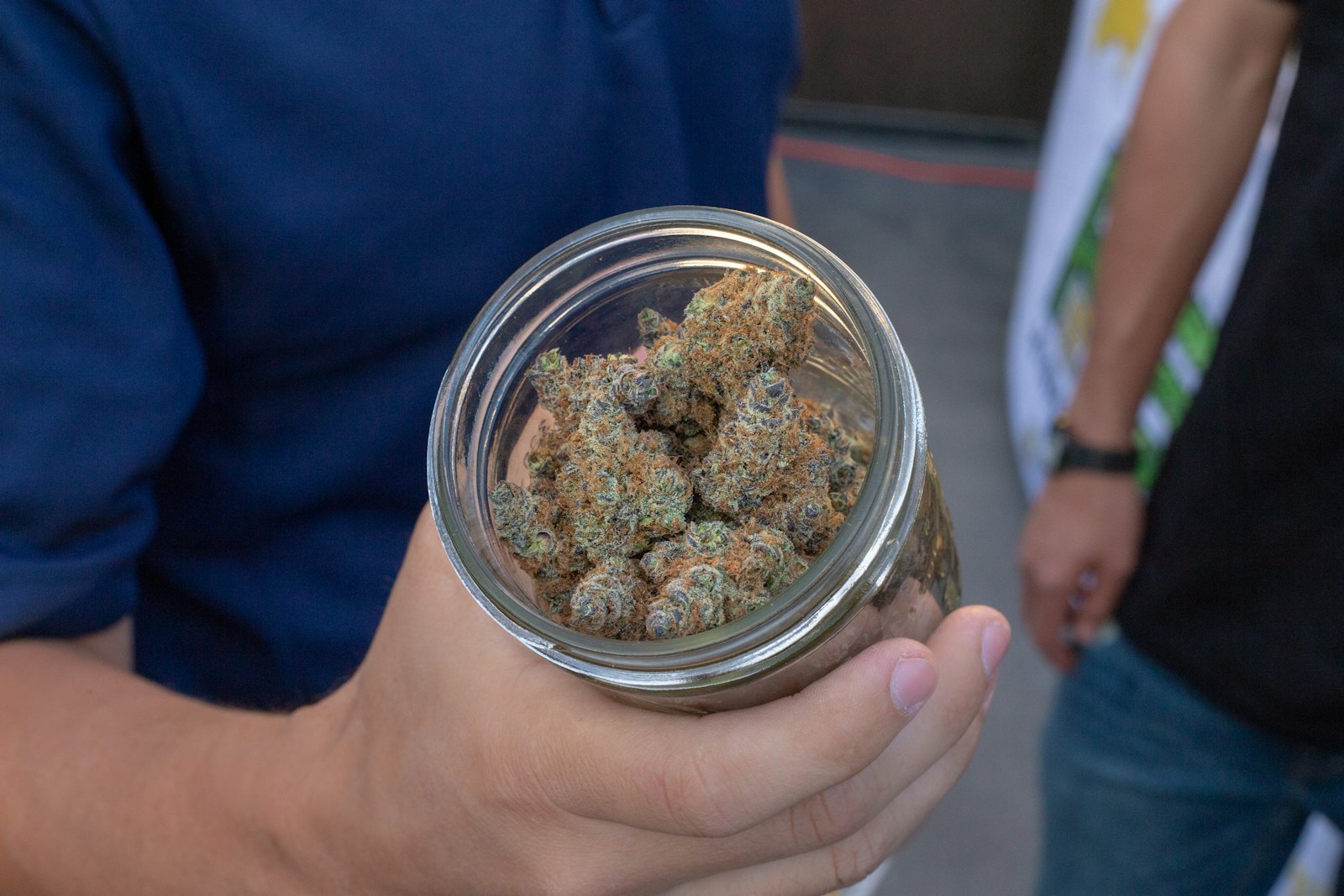
Yes, significantly. VSCs are volatile compounds that evaporate gradually over time, especially when exposed to heat, light, and air. Proper storage in an airtight glass container, kept cool and away from direct light, slows that loss considerably. Flower that has been stored poorly loses its sharpest top notes fastest. Fresh packaging date and good storage habits are the most reliable way to preserve the full aroma profile of any flower you buy.
The Bottom Line
Weed smells like a skunk because of one molecule it shares with actual skunk spray, light-struck beer, and garlic. The structural overlap is exact. Terpenes shape everything else about the aroma — the citrus, pine, earthy, and floral layers — but the skunk note belongs entirely to the VSC family. A strong skunk smell tells you the flower is fresh and properly cured. It doesn’t tell you the THC percentage, and no current lab report measures it. Your nose remains the only instrument available for that assessment. Visit The Purple Leaf to explore our flower selection and find the aroma profile that’s right for your preferences.
Shop related at The Purple Leaf: cannabis flower
Buy weed online in Canada · Same-day weed delivery in London, Ontario on weekday orders placed before noon (12:00 PM EST).