

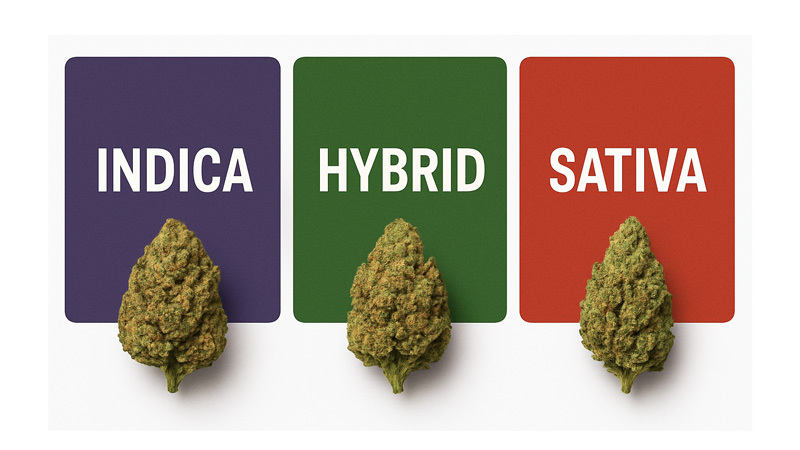
If you’ve spent any time looking at cannabis products, you’ve encountered the same three words on almost every label: sativa, indica, hybrid. These categories are the starting point for most cannabis conversations, and understanding what they actually mean — and where their limits are — makes shopping considerably easier. Here’s a plain-language breakdown of the five key differences between these strain types, along with what the science actually says about how reliable those labels are.
A Quick Introduction to the Three Categories
Cannabis has been cultivated across the world for thousands of years, developing into an enormous variety of strains with different chemical profiles, growth patterns, and effects. The cannabis industry broadly organizes these into three categories.
Indica strains originated in drier, harsher climates including parts of Afghanistan, Pakistan, and India. They grow shorter and bushier than sativa plants, tend to have denser buds, and are broadly associated with more physically relaxing, body-centred effects. The joking shorthand “in da couch” comes from how indica-leaning products are typically described: calm, heavy, and suited to quiet evenings.
Sativa strains developed in tropical, humid climates including Southeast Asia and Central America. They grow taller with lighter, airier buds and are broadly associated with a more uplifting, mentally engaged quality. They’re generally recommended for daytime use or social situations where mental alertness is welcome.
Hybrid strains are crossbreeds of indica and sativa genetics, bred deliberately by growers to combine characteristics of both parent plants. Most cannabis on the legal shelf today is technically hybrid to some degree. Products labelled hybrid lean either indica-dominant or sativa-dominant depending on which genetics are more prominent, with balanced 50/50 hybrids sitting in between.
With that foundation in place, here are the five key differences worth knowing. Browse The Purple Leaf’s full flower and product selection to explore all three strain types.
Difference 1: When and Where You Use Them
The most practical difference between these categories is timing and setting. Sativa-leaning products are generally better suited to situations where you want to remain engaged, social, or active. A sativa-forward strain works well for a camping trip, a creative afternoon, or time spent with friends. Indica-leaning products are better suited to winding down: quiet evenings at home, relaxing after a long day, or a slow Sunday where nowhere to be is the whole point.
Hybrid strains sit between the two, giving you a middle-ground experience that many consumers find useful precisely because it’s versatile. A balanced hybrid doesn’t commit you fully to either end of the spectrum, which makes it a popular everyday option for people who want something adaptable to different situations throughout the week.
Difference 2: Physical Characteristics and Bud Texture
The differences between indica and sativa aren’t only in effects. They’re visible in the plant itself and, to some extent, in the feel of the finished product.
Indica plants grow shorter with broader leaves and denser, more compact buds. That density makes indica flower stickier and more resinous, which is why a good grinder is particularly useful when working with indica-dominant whole flower. The dense bud structure takes more effort to break down by hand than a looser sativa bud.
Sativa plants grow taller with narrower leaves and lighter, less dense buds. The flower is generally easier to break apart, rolls more smoothly, and is less tacky to handle. If you roll your own joints, you’ll notice the difference in how the two types feel on the tray.
Hybrid buds land somewhere in between, varying based on which parent genetics are dominant. For anyone who prefers pre-rolled options or isn’t interested in managing bud texture, The Purple Leaf’s pre-roll selection takes that variable out of the equation entirely.
Difference 3: Cannabinoid Ratios — THC, CBD, and the Balance Between Them
Sativa-dominant strains generally lean more heavily toward THC relative to CBD. The more purely sativa a product is, the more its cannabinoid balance typically favours THC, which contributes to the cerebral, mentally engaged quality sativa-leaning products are associated with.
Indica-dominant strains tend to have a slightly more balanced THC to CBD ratio, sometimes approaching a 1:1 relationship in certain cultivars. The higher relative CBD content in indica-leaning products is linked to the body-forward, physically relaxing quality those strains are known for. It’s worth noting that CBD appears to moderate some of the more intense or anxious aspects of a THC experience, which is part of why indica strains are often described as feeling smoother and more settled.
Hybrid strains reflect whichever parent genetics are more dominant in their cannabinoid ratios. Reading the label — specifically the Total THC and Total CBD percentages — gives you more precise information than the strain classification alone.

Difference 4: Psychoactive Effects and How They Feel
This is the difference most people are shopping around, and it’s worth being precise about what each category actually tends to deliver.
Indica-dominant strains are associated with physical relaxation, muscle ease, and a quieter, more internally focused mental state. Many people describe a heavy, settled quality — the kind that pairs well with a movie, a comfortable spot on the couch, or sleep. The giggles, a sense of calm, and a general slowing-down are commonly reported.
Sativa-dominant strains are associated with an uplifted, energized, and more outward-facing mental quality. They’re linked to increased focus, creativity, social ease, and a head-forward experience rather than a body-forward one. For afternoon tasks, creative projects, or social situations, sativa-leaning strains are typically the recommendation.
Hybrid strains blend these qualities in proportions that vary by specific cultivar. A balanced hybrid might deliver mild physical relaxation alongside mental clarity without committing fully to either end of the spectrum. For consumers who find pure indica too sedating and pure sativa too stimulating, a well-chosen hybrid often hits the sweet spot.
It’s worth being honest about the limits of these descriptions: terpene profile, individual tolerance, dosage, and your own body chemistry all shape the experience just as much as the strain classification. Two products with the same indica label can feel meaningfully different. The strain type is a useful starting point, not a guarantee.
Difference 5: Flavour and Aroma Profiles
Different strain genetics produce different terpene profiles, and terpenes are what give cannabis its distinct aromas and flavours. This is one of the more genuinely consistent differences between the three categories.
Indica-dominant flower tends toward richer, deeper, and more pungent aromas: earthy, musky, skunky, and often with notes of dark fruit like grape or plum. These are fuller-bodied flavour profiles that many experienced consumers specifically seek out.
Sativa-dominant flower leans toward lighter, brighter, and more citrus-forward aromas: lemon, orange, apple, and tropical fruit notes. The flavour profile tends to be more diverse and slightly more delicate than indica, with fewer of the heavy earthy or gasoline undertones that define many indica-dominant strains.
Hybrid flower varies considerably depending on lineage. A sativa-dominant hybrid might carry citrus notes with a grounding earthiness underneath. An indica-dominant hybrid might have deep berry flavours with a brighter, fresher finish than a pure indica. The range within the hybrid category is the widest of the three.
The Honest Caveat: Labels Don’t Tell the Full Story
Here’s something worth knowing before you make your next purchase based solely on the indica or sativa label: decades of crossbreeding mean the genetic distinction between these two categories has become blurry. Researchers have found that strains labelled indica can be just as closely related to strains labelled sativa as they are to other indica strains. The label reflects the dominant characteristics producers and retailers are communicating based on lineage and terpene profile, not a clean botanical division.
This is where terpenes become your most useful tool as a consumer. Rather than stopping at “is this indica or sativa,” looking at the dominant terpenes tells you more about how a specific product is likely to feel.
Myrcene is the most common cannabis terpene and is strongly associated with physical relaxation and the classic indica body quality. Limonene is associated with uplifted, mood-forward effects and is more common in sativa-leaning strains. Pinene brings a sense of alertness and clarity. Caryophyllene adds a calming, settled quality without contributing to psychoactive intensity. Linalool, the dominant terpene in lavender, promotes physical ease and emotional openness.
Learning to read a terpene profile alongside the strain label gives you a significantly more accurate picture of what to expect. The team at The Purple Leaf can help you navigate these details and find the right product for your preferences and tolerance.
The Entourage Effect: Why the Whole Profile Matters
The entourage effect describes how cannabinoids and terpenes work together rather than in isolation. THC doesn’t act alone. CBD, minor cannabinoids like CBG and CBN, and the full terpene profile of a product all interact in ways that shape the overall experience. This is part of why full-spectrum products often feel different from isolate-based ones, and why identical THC percentages in two different strains can produce noticeably different results.
For consumers who want to go beyond the three-category system, looking at the complete cannabinoid and terpene profile of a product gives a more complete and reliable picture than the strain label alone. The Purple Leaf carries products across indica, sativa, and hybrid categories with detailed labelling to support more informed choices.
Frequently Asked Questions
Does it actually matter whether I choose indica, sativa, or hybrid?
It’s a useful starting point, but not the whole picture. For consumers with consistent preferences — those who always want to wind down or always want something social and energizing — the classification provides reliable direction. For everyone else, terpene profile, THC to CBD ratio, and personal trial and error fill in what the label alone can’t.
Are indica and sativa actually different plants?
Botanically, they’re both varieties of Cannabis sativa — the same species. Rather than different plants, think of them as different strain families with distinct growth characteristics and typical chemical profiles.
Why do two indica strains sometimes feel completely different?
Because the experience is shaped by more than the strain label. Terpene profile, specific cannabinoid ratios, potency, your individual tolerance, and how recently you’ve eaten all contribute. Two products with the same strain classification can have very different terpene profiles and feel meaningfully different as a result.
Do hybrids still get you high?
Yes. Hybrids contain THC and produce a high like any other cannabis product. What distinguishes them is the balance of effects drawn from their indica and sativa parent genetics rather than the presence or absence of psychoactive effects.
What’s the best strain type for a beginner?
A balanced hybrid or an indica-dominant product at a modest THC level is a common recommendation for beginners. Indica-leaning strains tend to feel more settled and less likely to tip into anxiety than sativa-dominant products at the same potency. As always, starting low and going slow applies regardless of strain type.
The Bottom Line
Sativa, indica, and hybrid are the three organizing categories of the cannabis world, and understanding what each one generally delivers makes navigating the shelf considerably more straightforward. Sativa for energy and social use, indica for relaxation and evenings, hybrid for the middle ground. Beyond those broad strokes, terpene profile and cannabinoid ratios give you the more precise picture that strain labels alone can’t provide. Visit The Purple Leaf to explore our full product selection across all three categories and find the right fit for your routine.
Shop related at The Purple Leaf: indica strains · sativa strains · hybrid strains
Buy indica strains online in Canada · Same-day weed delivery in London, Ontario on weekday orders placed before noon (12:00 PM EST).