

If you’ve ever stood in front of a cannabis shelf comparing two products purely by which one has the bigger THC number, you’re not alone. It’s one of the most natural instincts when you’re new to shopping for cannabis, and even experienced shoppers fall back on it out of habit. But that number, while useful, is really just the opening line of a much longer and more interesting story. This article breaks down what THC percentage actually means, why it isn’t the full picture, and how understanding a few other things on the label can help you find products that genuinely suit you — not just ones that look impressive on paper.
The Number on the Label Is a Starting Point, Not the Answer
THC, or tetrahydrocannabinol, is the primary cannabinoid responsible for the intoxicating, psychoactive effects associated with cannabis. The percentage listed on a legal Canadian cannabis product represents the total potential THC by weight — a snapshot of how much of the compound is present at the time of testing. It’s verified by third-party lab testing and gives you a reliable baseline for comparison. So far, straightforward.
The part that trips people up is treating that number as a direct predictor of experience. A 30% THC flower and a 20% THC flower aren’t guaranteed to produce experiences that are 50% more or less intense in proportion to their numbers. The percentage tells you about concentration. It doesn’t tell you about terpenes, your individual biology, the freshness of the product, or how much you actually consumed.
Chasing the highest number on the shelf often leads to products that feel overwhelming for some consumers or, paradoxically, less satisfying than a more moderately potent product with a richer terpene profile. Understanding what else is shaping the experience is what turns THC percentage from a confusing number into a genuinely useful data point. Browse The Purple Leaf’s flower selection to explore products across a range of THC levels and strain profiles.
What’s Actually Shaping Your Experience
Terpenes
Terpenes are the aromatic compounds that give different cannabis strains their distinct character — the citrus brightness of a limonene-forward sativa, the earthy musk of a myrcene-heavy indica, the spicy complexity of a caryophyllene-dominant hybrid. They’re present in the same flower as the THC, and they do considerably more than produce interesting smells.
Terpenes interact with cannabinoids in ways that shape the quality of the experience — not just the intensity of it. A product with a modest THC percentage and a rich, well-preserved terpene profile can produce a more layered, enjoyable, and strain-expressive experience than a high-THC product that’s lost most of its terpenes through improper curing or extended storage. This is part of why freshness matters so much: terpenes are volatile and degrade over time, particularly with exposure to heat, light, and air. The packaged-on date on a cannabis product isn’t just a quality indicator — it’s a terpene indicator.
The same Total THC and Total CBD rules apply to every product in Canada; our guide on how to read a CBD label walks through each line.
The Entourage Effect
THC doesn’t work in isolation. It interacts with CBD, minor cannabinoids like CBG and CBN, and the full terpene profile of a product in ways that influence how the experience feels. This collective interaction is commonly referred to as the entourage effect, and it’s one of the more compelling reasons why two products with identical THC percentages can feel meaningfully different from each other.
A product with meaningful CBD alongside THC tends to feel more balanced and settled than a THC-dominant product at the same percentage. Some consumers find that CBD moderates the more anxious aspects of a strong THC experience, making the overall result more comfortable. A product with a distinct terpene profile — myrcene for body warmth, limonene for mood lift, linalool for ease — adds further dimension beyond what the THC number alone can predict.
Your Individual Biology
Your personal tolerance, metabolism, body composition, and even your mood and environment on a given day all shape how any THC level lands. Two people consuming the same product in the same amount can have genuinely different experiences, and both are valid responses.
This is why the most reliable approach to finding your comfortable THC range is experimentation at a conservative pace, not simply choosing the product with the largest number. Your own accumulated experience with what works for you is ultimately more useful than any percentage on any label. The team at The Purple Leaf is happy to help you find a starting point and talk through what’s worked well for other consumers with similar preferences.
What Else to Look For on the Label
Terpene Profile
Some licensed producers list dominant terpenes on their packaging. When you see them, use them. Myrcene dominance points toward physical relaxation and body warmth. Limonene suggests a more uplifted, mood-forward experience. Caryophyllene adds a calming quality without contributing to psychoactive intensity. Pinene is associated with alertness and mental clarity. Linalool promotes physical ease and emotional openness.
These terpene characteristics are meaningful, practical information about how a product is likely to feel — often more meaningful than the THC percentage alone for consumers who already have a general sense of their comfortable potency range.
Packaged-On Date
Freshness matters more for cannabis than most consumers realize. THC can degrade into other compounds like CBN over time, particularly with exposure to light, heat, and oxygen. Terpenes, being volatile, fade even faster. A product tested at 25% THC several months ago may deliver a noticeably different experience today — not necessarily weaker in every sense, but different in character as the profile shifts.
Checking the packaged-on date and choosing the freshest available product is one of the simplest and most reliable quality decisions you can make at the shelf.
Extract Type
For oils, vapes, and edibles, the extract type matters alongside the THC percentage. Full-spectrum extracts retain a broader range of cannabinoids and terpenes from the plant, which many consumers find produces a more rounded, complete experience than isolate-based products at the same THC level. Isolate-based products are more predictable and consistent, which some consumers prefer. Neither is inherently better — knowing which you’re looking at helps you set accurate expectations.
Licensed Producer
Over time, most cannabis consumers develop a sense of which producers consistently deliver on quality, curation, and freshness. A brand that publishes comprehensive lab results, maintains consistent strain expressions from batch to batch, and is transparent about its growing and processing practices is worth paying attention to. That consistency is something you can’t read from the THC percentage alone.
Format Changes Everything
The THC percentage means different things depending on the format you’re consuming it in.
For dried flower and vapes, the percentage reflects concentration by weight. Effects arrive quickly — within minutes for inhalation — peak within about 30 to 60 minutes, and typically wind down within one to three hours. The fast feedback loop gives you real-time information about where you are, which makes it easier to pace yourself.
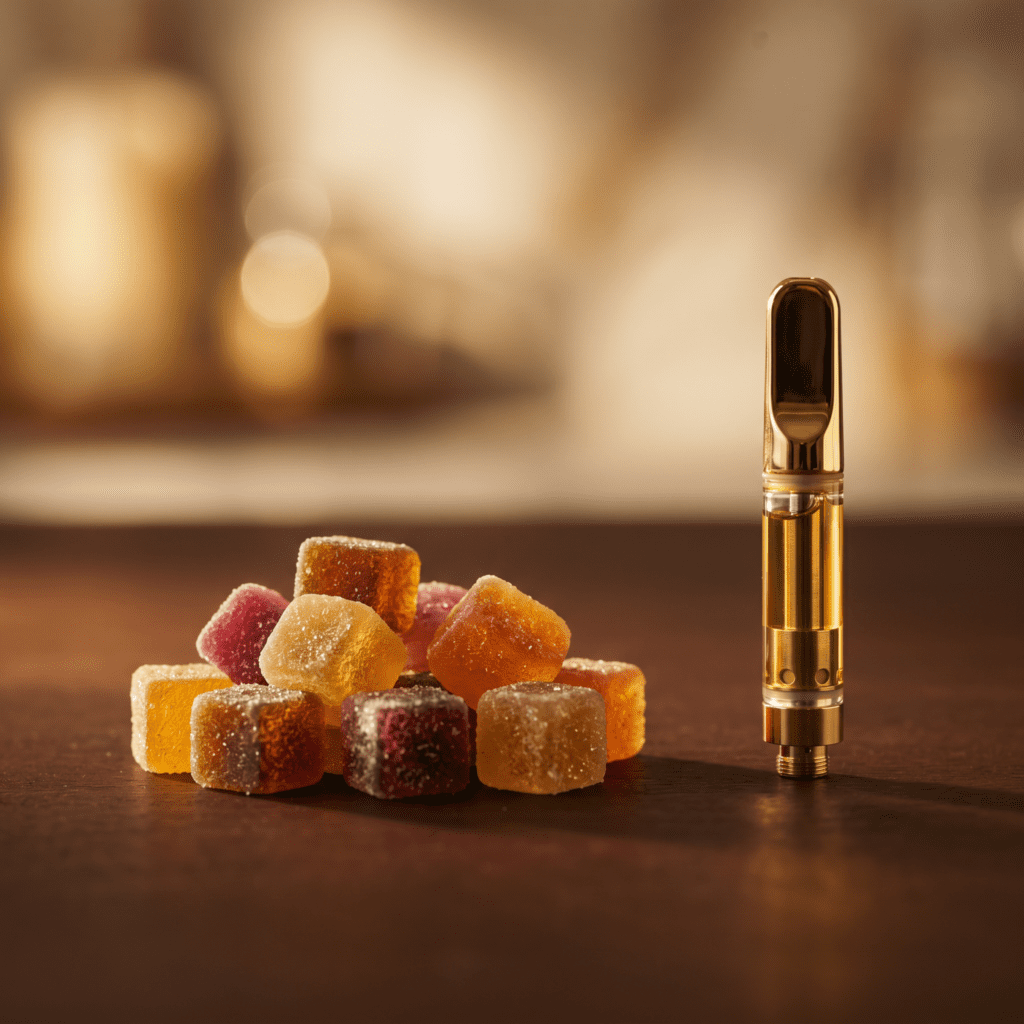
For edibles, THC is listed in milligrams per serving rather than as a percentage, and the onset is considerably slower — typically 30 minutes to two hours depending on your metabolism and stomach contents. Once they arrive, effects last significantly longer, often four to eight hours. At equivalent milligram counts, edibles can feel more intense than inhaled cannabis because your liver converts THC into 11-hydroxy-THC during digestion — a more potent and longer-lasting metabolite. This is why starting low with edibles matters even for experienced consumers who are comfortable with their preferred percentage in flower or vapes. The Purple Leaf carries edibles across a range of THC levels clearly labelled in milligrams per serving so you can compare options accurately.
For vape cartridges, the percentage listed reflects the concentration within the oil itself, and the experience shares more in common with inhaled flower in terms of onset and duration than with traditional edibles.
Practical Questions Worth Asking Before You Buy
The right product isn’t the one with the highest number — it’s the one that aligns with how you actually want to feel and what you’re planning to do afterward. Before you choose, it helps to work through a few practical questions.
What kind of experience are you looking for? Relaxing and body-forward, uplifting and mentally engaged, or something balanced in the middle? That answer points you toward indica, sativa, or hybrid classifications and toward specific terpene profiles.
What’s your current tolerance? If you’re newer to cannabis or returning after time away, starting lower than you think you need to is always the right instinct. A modest THC level experienced at the right dose is far more enjoyable than a high-THC product at too much.
How long do you want the experience to last? If you want something that winds down predictably in a couple of hours, an inhaled format is more appropriate than an edible.
What format fits your situation? The same THC content in a vape and a gummy produces a different timeline and a different character of experience. Matching the format to your actual plans makes the whole thing more comfortable.

Storing Your Product Properly
Once you’ve found a product that works well, protecting it between sessions preserves both the THC and the terpenes that made it worth buying.
Keep your flower, oil, or cartridge in an airtight container away from direct light and heat. For flower specifically, a glass jar with a proper seal at room temperature in a cool cupboard is ideal. A humidity pack in the 58 to 62% relative humidity range inside the jar helps maintain moisture and terpene integrity over time. Avoid leaving products in a hot car, near a window, or in any environment with significant temperature fluctuation — heat is the fastest way to degrade both potency and aroma.
Common Questions About THC Percentage
Does higher THC always mean a stronger experience?
Not reliably. THC percentage tells you about concentration in the plant material at time of testing. How intense the experience actually feels depends on terpene profile, your individual tolerance and metabolism, how much you consume, the format, and a range of other factors. A lower-THC product with a rich, intact terpene profile can produce a more satisfying experience than a high-THC product that’s lost most of its aromatic character.
Can THC percentage change after I buy the product?
Yes. Exposure to light, heat, and oxygen can gradually convert THC into other cannabinoids like CBN over time. This shifts the experience rather than simply reducing it, but it’s one reason freshness matters and why checking the packaged-on date before you buy is worth the extra moment.
How do I figure out what THC level works for me?
Start lower than you think you need to and give each session time before you decide whether to adjust. One session at a conservative level tells you more about your own response than any percentage on any label. Over time, your accumulated experience becomes your most reliable guide — more reliable than any number printed on the package.
Why do edibles list milligrams instead of percentages?
Because milligrams measure the total amount of THC in a specific serving, which is more practically useful for a precisely dosed product than a percentage by weight. A gummy with 5mg of THC contains exactly 5mg regardless of its weight, which gives you a direct, comparable dosing reference. For flower, percentage by weight reflects the concentration throughout the plant material rather than a fixed per-piece amount, which is why the two units are different and shouldn’t be compared directly.
What’s the best THC percentage for a beginner?
This varies by person and format. For flower, products in the 15 to 18% Total THC range are often recommended as approachable starting points — noticeable without being overwhelming for most newer consumers. For edibles, 2.5mg to 5mg is the standard beginner recommendation. For vapes, one slow draw and a ten-to-fifteen-minute wait before continuing gives you time to gauge your response before going further. The percentage is less important than consuming a small amount and giving it time to register.
The Bottom Line
THC percentage is a useful starting point, not the whole story. The experience that percentage produces in your body depends on terpene profile, freshness, cannabinoid balance, your individual tolerance, the format you’re consuming it in, and how much you actually take. Once you look at the label with all of those variables in mind rather than just the biggest number, the choice becomes considerably more informed and considerably more likely to result in an experience you actually enjoy. Visit The Purple Leaf to browse our current selection and find the right product for your preferences and tolerance level.
Shop related at The Purple Leaf: cannabis flower · concentrates
Buy weed online in Canada · Same-day weed delivery in London, Ontario on weekday orders placed before noon (12:00 PM EST).