

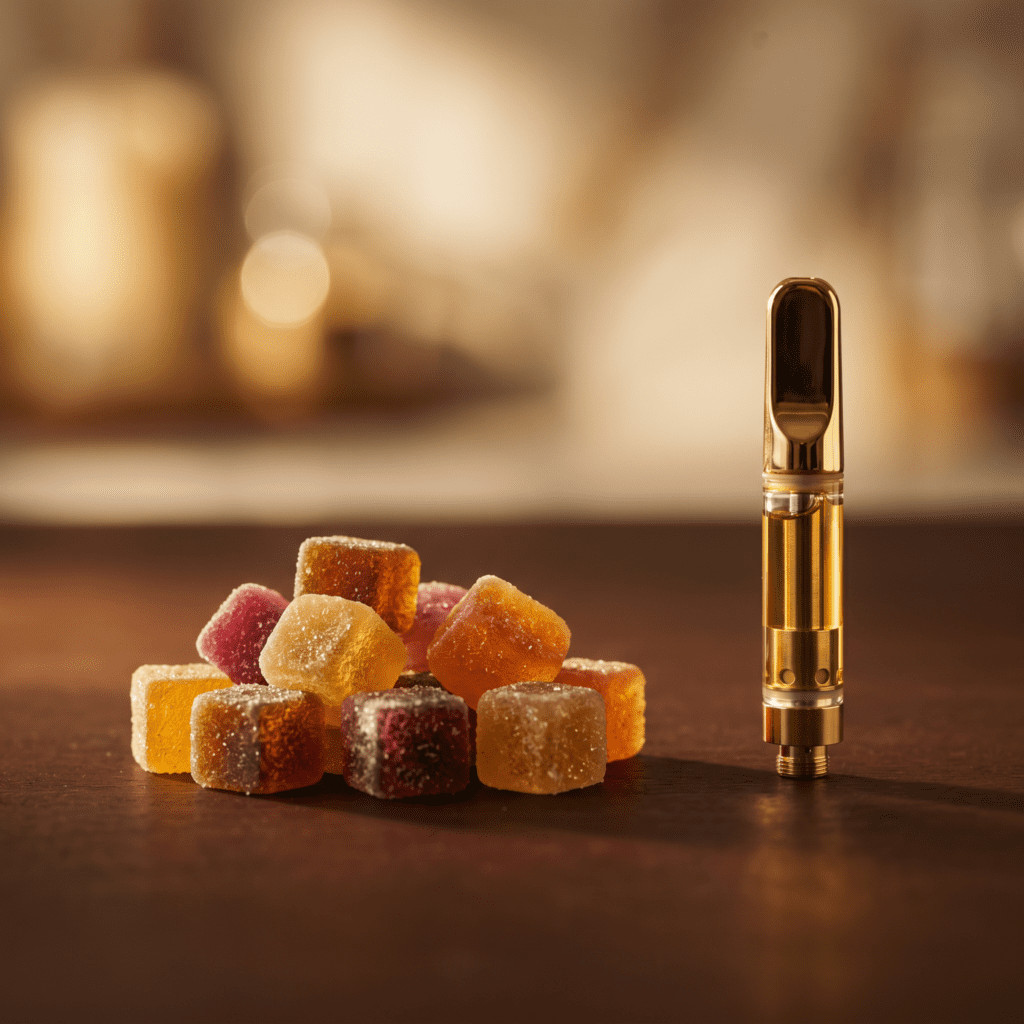
Edibles take 30 to 90 minutes to kick in and last four to eight hours. Vapes take effect within minutes and wind down in one to three hours. That single difference — onset versus duration — is the most useful thing to understand when choosing between the two formats, and everything else follows from it.
This guide covers the full comparison: how each format works in your body, what the experience actually feels like, how to approach dosing for each, when to use one versus the other, and how to combine them if you want the flexibility of both. Both formats are available in Canada’s legal cannabis market, clearly labelled with verified cannabinoid content and sold through licensed retailers like The Purple Leaf.
How Each Format Works in Your Body
The core difference between edibles and vapes isn’t just timing — it’s the absorption pathway, and that changes the entire character of the experience.
When you eat a cannabis edible, THC passes through your digestive system and is processed by the liver before entering your bloodstream. During that liver processing, THC converts into 11-hydroxy-THC, a metabolite that crosses the blood-brain barrier more efficiently than inhaled THC. The result is an experience that many people describe as more body-forward, more immersive, and longer-lasting than inhaled cannabis at equivalent doses.
When you vape cannabis, cannabinoids travel from your lungs directly into the bloodstream, bypassing digestion and liver conversion entirely. Onset happens within minutes and the effects are easier to read in real time, which makes pacing considerably more straightforward. The experience tends to feel more cerebral and less physically heavy than edibles at comparable amounts.
Same cannabinoid, different pathway, genuinely different experience. Understanding that distinction is what lets you choose the right format for the right moment rather than wondering why two products at the same THC percentage felt nothing alike.
Onset, Duration, and Intensity: The Full Comparison
| Edibles | Vapes | |
|---|---|---|
| Onset | 30 to 90 minutes | 1 to 10 minutes |
| Peak | 2 to 3 hours after consuming | 15 to 30 minutes after consuming |
| Duration | 4 to 8 hours | 1 to 3 hours |
| Intensity feel | Body-forward, immersive, longer-lasting | More cerebral, easier to pace |
| Ease of dosing | Fixed, pre-measured per piece | Controlled draw by draw |
| Discreetness | High — no vapour, no smell mid-use | Moderate — vapour dissipates quickly |
| Setup required | None | Battery charged, cartridge attached |
The Purple Leaf carries both cannabis edibles and vape products across a range of formats, THC levels, and strain profiles.

Edibles in Depth
What Makes Edibles Different
The liver conversion to 11-hydroxy-THC is the defining chemistry behind why edibles feel the way they do. At equivalent milligram counts, the experience from an edible can feel more intense and considerably longer-lasting than the same amount vaped. This is worth knowing before you consume, because treating a gummy the same way you’d treat a single vape draw is the most common source of difficult experiences.
The 10mg per package cap that Health Canada places on all legal cannabis edibles in Canada is a practical reflection of this reality — it creates a standardized ceiling that makes dosing decisions clearer and more consistent across every product on the shelf.
The Onset Window and Why It Matters
The 30 to 90 minute onset range is real, and the variance within it reflects genuine individual differences. Your metabolism, body composition, liver enzyme levels, what you’ve eaten, and when you last consumed cannabis all affect where in that range you personally land on any given day. Some people consistently feel edibles at the 40-minute mark. Others need closer to two hours.
The practical consequence is that the absence of noticeable effects at the 45-minute mark tells you almost nothing about where you’ll be at the two-hour mark. This is why the 90-minute rule exists: wait a full 90 minutes before deciding whether to consume more. Taking more because nothing seems to be happening at 45 minutes, and then having both doses arrive together, is the most common edible mistake in any context.
Some edibles use nano-emulsification technology — the same approach used in many cannabis beverages — which speeds absorption by breaking THC into smaller, water-soluble particles that absorb through the stomach lining before full digestion and liver processing occur. Products labelled as fast-acting typically produce onset within 15 to 30 minutes rather than the standard window. If precise timing matters, a fast-acting edible bridges the gap between standard edibles and vapes without requiring inhalation.
Who Edibles Suit Best
Edibles suit consumers who want a longer, more sustained experience. A single properly dosed edible can carry through an evening with no need to manage top-ups, which makes them particularly practical for long, slow sessions or any situation where you want to consume once and then simply enjoy what follows. They’re also the most discreet format available — nothing to light, no vapour, no smell during use, and a product that looks exactly like any other packaged food item.
For anyone looking for lung-free cannabis consumption, edibles and oils are the two primary options, and edibles offer the additional convenience of pre-measured, clearly labelled dosing without any accessories or preparation.
Vapes in Depth
What Makes Vapes Different
A vape pen or cartridge heats cannabis extract to a temperature that vaporizes the active compounds without combustion. The result is an inhalable vapour that delivers cannabinoids directly into the bloodstream through the lungs. Effects arrive within minutes, peak relatively quickly, and taper off in a more predictable timeframe than edibles.
This immediacy gives you real-time feedback that edibles don’t offer. You know where you are within minutes of your first draw, which makes it much easier to gauge whether you want more before the effects have already plateaued.
Types of Vapes in Canada’s Legal Market
510-thread cartridges are the most flexible format, attaching to a separate battery that’s reused as you swap cartridges. A variable-voltage battery lets you adjust temperature to preserve terpenes at lower settings or produce denser vapour at higher ones. This setup gives you the most control over the experience at a lower long-term cost per gram of oil.
All-in-one disposable vape pens are self-contained — battery, coil, and cannabis oil in a single unit that requires no setup. Draw-activated, no charging between sessions for most, and compact enough to fit anywhere. The most convenient format for new consumers or anyone who doesn’t want to manage a separate battery.
Dry herb vaporizers heat actual cannabis flower rather than extracted oil. The terpene profile of well-grown flower comes through more fully in a dry herb vape than in most oil-based cartridges, and temperature control lets you shape the session from lighter and flavour-forward at lower settings to denser and more potent at higher ones.
Who Vapes Suit Best
Vapes suit consumers who want precise, real-time control over their session. Because effects arrive quickly and taper off within a few hours, you can make adjustments mid-session in a way that isn’t possible with edibles. They’re also well-suited to social settings where you want to manage intake across an evening rather than committing to a single dose upfront.
For consumers who’ve had difficult experiences with edibles — typically from taking too much before the first dose arrived — vapes offer a more forgiving learning curve. You feel what’s happening in real time, which makes it considerably easier to stop before going further than you intended. The Purple Leaf’s vape selection spans cartridges, all-in-ones, and dry herb options across indica, sativa, and hybrid strain profiles.
Dosing: How Each Format Is Measured
In edibles, the amount is expressed in milligrams per piece or per serving. A gummy labelled 5mg of THC contains 5mg of THC per piece. This fixed, pre-measured approach removes guesswork from the equation and makes it easy to be deliberate about how much you consume. Canada’s legal edibles market caps products at 10mg of THC per serving, which provides a standardized ceiling across every product.
In vapes, the amount is expressed as a THC percentage in the oil. You control your intake through the length and number of draws rather than through a fixed unit. This requires a bit more self-awareness, particularly for newer consumers who don’t yet have a clear sense of what a comfortable amount feels like. One or two draws and a ten-minute wait is the right approach with any new vape product before deciding whether to continue.
For first-time consumers with either format, starting conservatively and giving the product time to register before assessing whether more is needed applies equally to both. The consequences of taking more than intended are harder to walk back with edibles because of the longer duration — which is why the fixed, pre-measured nature of a low-dose edible is particularly practical for first-time consumers who want predictability.
Can You Use Both Formats Together?
Yes, and many regular cannabis consumers do. The two formats complement each other in ways that using either alone doesn’t fully cover.
A common approach is to use a vape for a faster-onset experience in social or on-the-go situations, and an edible for longer evenings at home where duration is the point. Some consumers layer them in a single session — a few vape draws for quick onset while waiting for an edible to arrive — though this requires extra attention to pacing, since both will eventually be contributing simultaneously.
If you’re considering combining formats, the most important principle is to treat your total intake across both as a single number rather than separate ones. An edible dose that felt manageable on its own can feel like too much if vape draws have been stacking on top of it. Start with less of each than you’d usually take individually and give the edible its full onset window before reassessing.
Making the Choice
One question resolves most of the comparison: do you need it to work now, or do you need it to last?
Vapes win on speed. Effects in minutes, easy to pace in real time, practical for social settings or situations where you want flexibility. Edibles win on duration. A single dose that carries through several hours, no repeat consumption needed, no inhalation, maximum discretion.
Neither is objectively better. They’re different tools that suit different moments, and having access to both gives you the flexibility to match the format to what the occasion actually calls for. Both are available through Canada’s legal cannabis market with verified cannabinoid content and standardized labelling. Visit The Purple Leaf to browse our edibles and vape selections and find the right format for your next session.
For use by adults of legal age only. Do not drive after consuming cannabis. This article is for informational purposes only and is not medical advice.
Frequently Asked Questions
Are edibles stronger than vapes?
Not necessarily, but they often feel more intense. The liver converts THC into 11-hydroxy-THC during digestion, a metabolite that many people experience as more body-forward and longer-lasting than inhaled THC at equivalent doses. The experience is different rather than simply stronger.
How long should I wait after an edible before vaping?
Give the edible its full onset window — at least 90 minutes, ideally two hours — before adding anything else. Adding vape draws before the edible has finished building is how sessions become more than intended.
Which format is better for a first-time cannabis consumer?
A low-dose edible (2.5mg to 5mg) or a single careful vape draw are both practical starting points. Vapes offer faster feedback, which makes it easier to gauge your response before going further. Edibles offer fixed, pre-measured doses that remove guesswork. Either works as a first experience — the key is starting conservatively with both.
Do edibles and vapes show up on a drug test?
Yes. THC from either format is detectable in standard drug tests. Legal status in Canada doesn’t change detectability.
Which lasts longer, edibles or vapes?
Edibles last considerably longer. Most people experience effects for four to eight hours from an edible, compared to one to three hours from a vape session. If duration is the priority, edibles are the clear choice.
Is vaping better than edibles for discretion?
Edibles are more discreet in use — no vapour, no visible consumption, no smell during use. Vapes produce vapour that dissipates quickly but is briefly visible during use. For maximum discretion in any environment, edibles have a clear advantage.
What’s the best format for social settings?
Vapes tend to suit social settings better because you can manage intake in short bursts and adjust in real time based on how you’re feeling. Edibles commit you to a dose that takes time to arrive and lasts several hours regardless of how the evening unfolds — which suits a planned, settled evening more than a dynamic social one.
Buy THC edibles online in Canada · Same-day weed delivery in London, Ontario on orders before 12:00 PM EST.