

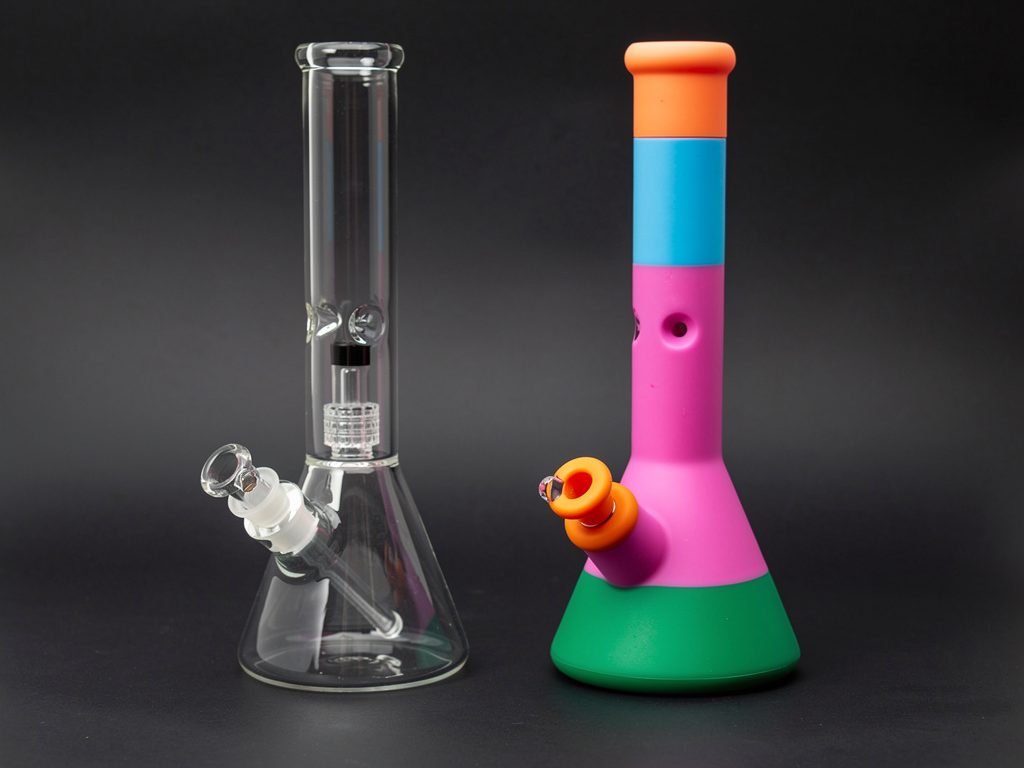
Choosing between a silicone and glass bong comes down to one honest question: what matters most to you in a piece? Both materials work — both filter smoke through water, both deliver a meaningfully smoother experience than a pipe or a joint, and both are widely used by experienced cannabis consumers across Canada. The differences are real, but they’re differences of priority, not of quality.
This guide covers the comparison across every factor that actually matters — durability, flavour, cleaning, heat resistance, portability, and price — so you can make a confident decision for your specific situation.
What Glass Bongs Are and Why They Dominate
Glass has been the default bong material for decades — and for good reason. Most quality glass bongs are made from borosilicate glass — a heat-resistant, chemically stable material that handles the thermal stress of repeated heating and cooling without cracking. It’s the same material used in laboratory glassware and quality kitchen ovenware, chosen specifically for its durability under temperature change.
Borosilicate glass is completely non-reactive with cannabis smoke at any temperature you’d encounter in normal use. It adds nothing to the flavour of what passes through it and takes nothing away. The result is the cleanest possible expression of whatever you’re smoking — which is why experienced users who care about terpene expression and flavour quality consistently default to glass.
The visual transparency of glass is also genuinely useful — you can see the smoke building in the chamber and time your clear accordingly, you can monitor the water level without guessing, and you can tell at a glance when the piece needs cleaning.
Browse our bongs section at The Purple Leaf for currently available glass options.
What Silicone Bongs Are and What They Do Differently
Silicone bongs are made from food-grade silicone — the same material used in high-temperature kitchen tools, baking moulds, and medical devices. It’s flexible, virtually indestructible under normal use conditions, and completely safe at the temperatures involved in cannabis consumption.
The practical differences from glass start with what silicone doesn’t do — it doesn’t shatter. You can drop a silicone bong from a significant height onto a hard floor and it will bounce, flex, and survive intact. For users who have a history of breaking glass pieces, this is a genuinely compelling argument.
Silicone bongs are also typically foldable or collapsible — the material’s flexibility allows many designs to be compressed into a fraction of their normal size for storage or transport. A silicone bong can live in a bag, survive being sat on, and be pulled out ready to use in seconds.

The Head-to-Head Comparison — What Each Material Does Better
Durability
Silicone wins decisively. A quality silicone bong is essentially unbreakable under normal use conditions. Drop it, knock it off a table, pack it in a bag with other items — it absorbs impact without consequence. Quality borosilicate glass is significantly more durable than standard glass and handles normal, careful use without issues — but it will break if dropped hard onto a solid floor. There is no comparison in this category between the two materials.
Verdict: Silicone for anyone who has broken glass pieces before, lives with clumsy people or pets, or simply doesn’t want the stress of owning a breakable item.
Flavour
Glass wins clearly. This is the most consistently cited reason experienced users prefer glass, and the reasoning is straightforward. Glass is completely chemically inert — it adds absolutely nothing to the flavour of the smoke that passes through it. Some users notice a very subtle difference with silicone — particularly with older or lower-quality silicone — that they describe as a faint plasticky character.
Food-grade silicone from a reputable manufacturer is generally considered flavour-neutral in practice. However, the theoretical purity of glass is complete — no perception of material contribution is even possible — which is why flavour-focused users default to glass without hesitation.
Verdict: Glass for users who prioritise the cleanest possible flavour expression from their flower. High-quality silicone is acceptable for users who are less focused on this dimension.
Cleaning
Silicone wins on convenience, glass wins on thoroughness. Silicone bongs can often be disassembled into individual components, placed in the top rack of a dishwasher, and come out clean without any chemical cleaning required. This is genuinely convenient and means regular cleaning requires almost no effort.
Glass cleaning requires more deliberate effort — a mixture of isopropyl alcohol and coarse salt shaken through the piece dissolves resin effectively, but it takes more time and attention than a dishwasher cycle. The advantage of glass is that it can be cleaned completely transparent — you can see that every surface is clean because you can see through it. With silicone, residue can hide in folds or textured areas that aren’t immediately visible.
Verdict: Silicone for hassle-free maintenance. Glass for users who want absolute certainty that their piece is completely clean.
Browse our cleaner products at The Purple Leaf for glass-specific cleaning solutions.
Heat Resistance
Both perform well — with different characteristics. Quality borosilicate glass handles the heat of cannabis consumption without any issues and can manage rapid temperature changes — hot smoke through cold water — without cracking. This is specifically what borosilicate was engineered for. Food-grade silicone is similarly heat-resistant up to temperatures well above anything encountered in normal bong use.
The practical difference is how they handle accidental contact with an open flame. A lighter flame briefly touching glass produces no damage. The same flame on silicone can cause surface discolouration or minor melting if held long enough. This is almost never an issue in normal use but worth being aware of if you use a torch lighter near a silicone piece.
Verdict: Both are fully adequate for normal cannabis use. Glass has the marginal edge in extreme heat scenarios.
Portability and Storage
Silicone wins comprehensively. A glass bong requires careful transport — padded cases, separate storage, deliberate handling. It’s not an item you toss in a backpack and hope for the best. A silicone bong, by contrast, can be folded, compressed, stored in a pouch, and transported with essentially no concern about damage. For users who want to bring a bong to a friend’s place, on a camping trip, or anywhere that involves some degree of transit, silicone eliminates a significant stress.
Verdict: Silicone for transport and storage. Glass for static home use.
Aesthetics
Glass wins for most users. Quality glass bongs — particularly hand-blown borosilicate pieces with colour work, complex percolation systems, or artistic designs — are genuinely beautiful objects. The transparency of glass, the way light interacts with it, and the range of artistic expression available in glass blowing produce pieces that many users find as satisfying to look at as to use.
Silicone bongs are available in a wide range of colours and some interesting shapes — they can be visually appealing in a different way. But they don’t replicate the specific aesthetic quality of quality glass, and they can’t accommodate the same range of artistic expression. If the piece living on your shelf is as important as how it performs, glass is the clear choice.
Verdict: Glass for aesthetics. Silicone for colour variety and visual novelty.
Price
Silicone wins at the entry level, glass wins at the premium end. Basic silicone bongs are among the most affordable cannabis accessories available — an entirely functional piece for a modest investment. Entry-level glass bongs are similarly accessible. As you move up the price range, glass pieces extend significantly further — quality hand-blown borosilicate with complex percolation and artistic design can command meaningful prices, but the performance and aesthetic difference justifies it for invested buyers. Silicone doesn’t extend into this premium territory in the same way.
Verdict: Silicone for the most accessible entry point. Glass for users who want to invest in a quality long-term piece.

The Percolator Question — Does It Apply to Both?
Percolators — the internal water filtration components that further diffuse and cool smoke — are most commonly found in glass bongs, where the transparent material allows complex internal designs to be shaped and appreciated. Multi-chamber percolation, tree percs, honeycomb percs, and showerhead percs are almost exclusively glass territory.
Silicone bongs typically offer simpler filtration — a basic diffused downstem rather than complex internal percolation. This is a meaningful functional difference for users who have experienced quality glass percolation and know the difference it makes to draw smoothness.
If advanced percolation is important to your session quality, glass is the appropriate choice. For users who want functional water filtration without complexity, both materials deliver.
Which Should You Choose?
Choose glass if: Flavour purity matters to you, you consume from a fixed home setup and won’t be transporting the piece regularly, you appreciate the aesthetic of quality glass, you want access to complex percolation designs, or you’re investing in a long-term piece that you’ll take care of.
Choose silicone if: You have a history of breaking glass pieces, you want to transport your bong regularly, you share a home with pets or children and need something genuinely unbreakable, you want the simplest possible cleaning experience, or you’re buying a secondary travel piece to complement a glass home setup.
Own both if: You’re a regular consumer who wants a quality glass piece for home sessions and a silicone piece for travel and outdoor use. This combination covers every scenario without compromise.
Keeping Your Bong Clean Regardless of Material
The single most consistent recommendation across both materials: clean more often than you think you need to. Stale bong water is the most common reason a bong produces harsh, unpleasant-tasting smoke — and it develops faster than most users expect. Fresh water for every session is the minimum.
For glass: isopropyl alcohol and coarse salt, shaken through the piece, dissolves resin effectively. Rinse thoroughly with warm water and allow to dry before the next session. Browse our cleaner products at The Purple Leaf for purpose-specific glass cleaning solutions.
For silicone: warm soapy water and a brush handles most cleaning. For deeper cleaning, many silicone pieces are dishwasher-safe — check the manufacturer’s guidance for your specific piece. Avoid isopropyl alcohol on silicone — it can degrade the material over time.
Frequently Asked Questions
Are silicone bongs as good as glass bongs?
For durability and portability, silicone is superior. For flavour purity and aesthetics, glass is superior. Both deliver functional water-filtered cannabis consumption. The right choice depends on your priorities. Browse our bongs section at The Purple Leaf.
Does silicone affect the taste of cannabis smoke?
High-quality food-grade silicone is generally considered flavour-neutral in practice. Some users notice a very subtle difference compared to glass — particularly with lower-quality silicone. Quality borosilicate glass is completely chemically inert and adds nothing to flavour under any circumstances.
Are silicone bongs safe?
Yes, when made from food-grade silicone. This is the same material used in kitchen bakeware and medical devices and is safe at temperatures well above those encountered in cannabis consumption.
Can you put a silicone bong in the dishwasher?
Many silicone bongs are dishwasher-safe on the top rack — check the manufacturer’s guidance for your specific piece. Do not put glass bongs in the dishwasher.
How do you clean a glass bong?
Isopropyl alcohol and coarse salt shaken through the piece dissolves resin effectively. Rinse thoroughly with warm water. Browse our cleaner products at The Purple Leaf for purpose-built cleaning solutions.
Where can I buy bongs in London, Ontario?
The Purple Leaf carries bongs and a full range of cannabis accessories available for local London, Ontario delivery and Canada Post shipping Canada-wide. Browse our bongs section at thepurple-leaf.com or call 519-777-9498 Monday to Friday, 9 AM to 8 PM EST.
Shop Bongs and Cannabis Accessories at The Purple Leaf
Whether you’re after a quality borosilicate glass piece for home sessions or a durable silicone option for travel, The Purple Leaf has the accessories and the flower to complete the setup.
Same-day weed delivery in London, Ontario on weekday orders placed before noon (12:00 PM EST).